

The NEP 2020 School Readiness Checklist helps school leaders evaluate whether their curriculum, teaching methods, assessment systems and infrastructure align with the National Education Policy 2020.
The policy introduces a 5+3+3+4 curricular structure and emphasises foundational literacy, competency-based learning, vocational education and holistic development. However, translating these recommendations into everyday classroom practices requires proper planning and teacher preparedness.
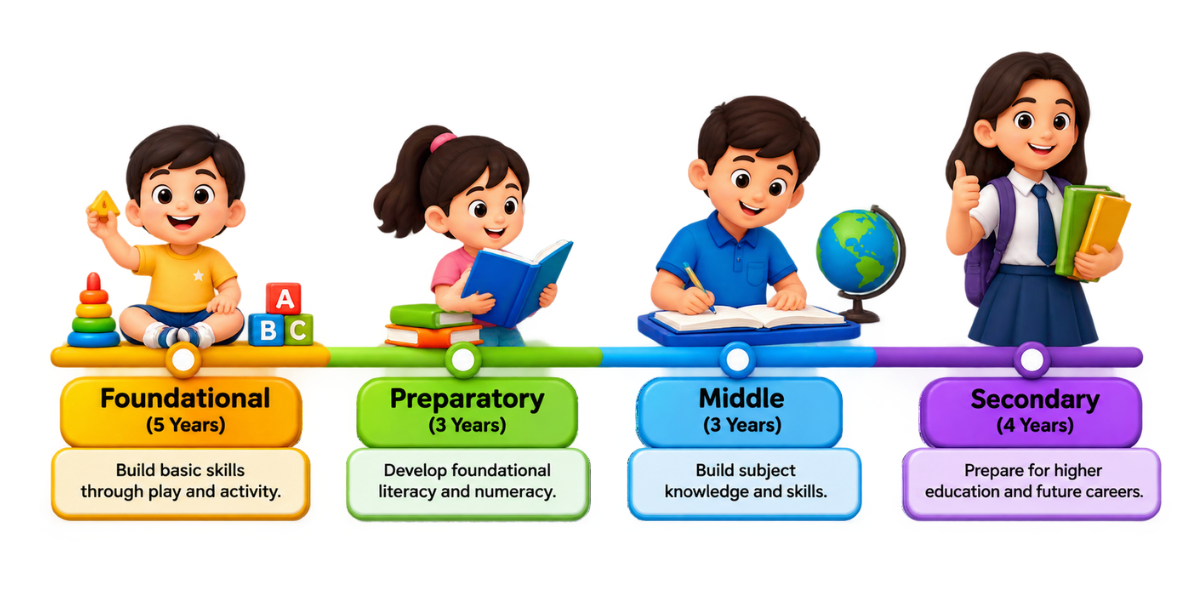
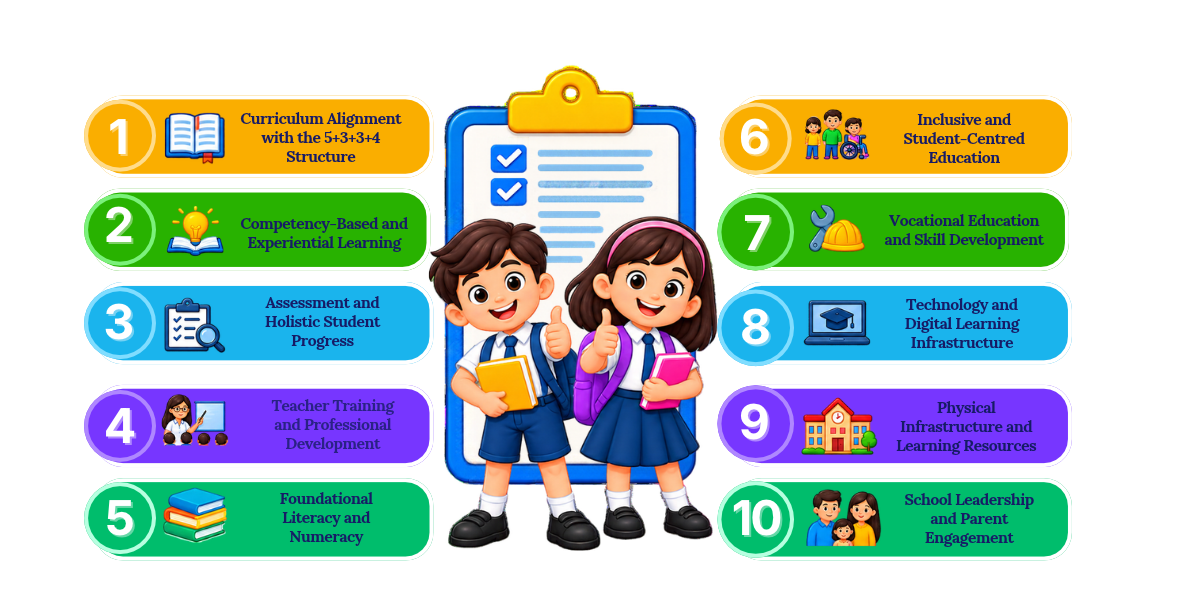
Here are 10 key areas schools should evaluate to understand their readiness for NEP 2020.
Key Takeaways
- NEP 2020 readiness involves reviewing curriculum, teaching methods, assessment and school infrastructure.
- Schools should evaluate 10 key areas to identify implementation gaps.
- Teacher training and competency-based learning are essential for effective implementation.
- A structured readiness assessment helps schools prioritise improvements.
- Regular monitoring and stakeholder collaboration support long-term progress.
NEP 2020 School Readiness Checklist: 10 Key Areas
1. Curriculum Alignment with the 5+3+3+4 Structure
Review whether academic planning reflects the Foundational, Preparatory, Middle and Secondary stages. Ensure that learning outcomes, subject planning and teaching approaches are appropriate for each age group.
2. Competency-Based and Experiential Learning
Evaluate whether classroom activities encourage critical thinking, creativity, communication and problem-solving. Introduce projects, experiments, group activities and real-world learning experiences instead of relying entirely on rote memorisation.
3. Assessment and Holistic Student Progress
Move beyond examinations focused only on marks. Use quizzes, presentations, projects and formative assessments to evaluate conceptual understanding, practical application and students' overall development.
4. Teacher Training and Professional Development
Assess whether teachers understand NEP 2020 recommendations and can implement experiential, inclusive and competency-based teaching. Regular training, mentoring and peer learning can strengthen classroom practices.
5. Foundational Literacy and Numeracy
Ensure that students in early grades develop essential reading, writing and mathematical skills. Conduct regular assessments, identify learning gaps and provide additional academic support where required.
6. Inclusive and Student-Centred Education
Review whether classrooms accommodate different learning abilities and needs. Provide accessible learning materials, differentiated teaching methods and appropriate support to encourage participation from every student.
7. Vocational Education and Skill Development
Introduce age-appropriate practical activities, vocational exposure and skill-based projects. Connect classroom learning with local occupations, industries and real-world experiences.
Explore our Vocational Education Program to learn more about our approach to skill-based learning.
8. Technology and Digital Learning Infrastructure
Evaluate access to digital devices, internet connectivity and educational resources. More importantly, ensure teachers can use technology meaningfully to support teaching, learning and assessment.
Explore our Learning & Assessment Program to strengthen learning outcomes and support educators’ professional growth through effective learning strategies and skill development.
9. Physical Infrastructure and Learning Resources
Review the availability of suitable classrooms, libraries, laboratories, sports facilities, sanitation and accessible learning spaces. Prioritise improvements according to student needs and available resources.
10. School Leadership and Parent Engagement
Establish clear academic improvement priorities and responsibilities. Encourage collaboration between school management, teachers and parents to ensure that NEP-related initiatives are implemented consistently.
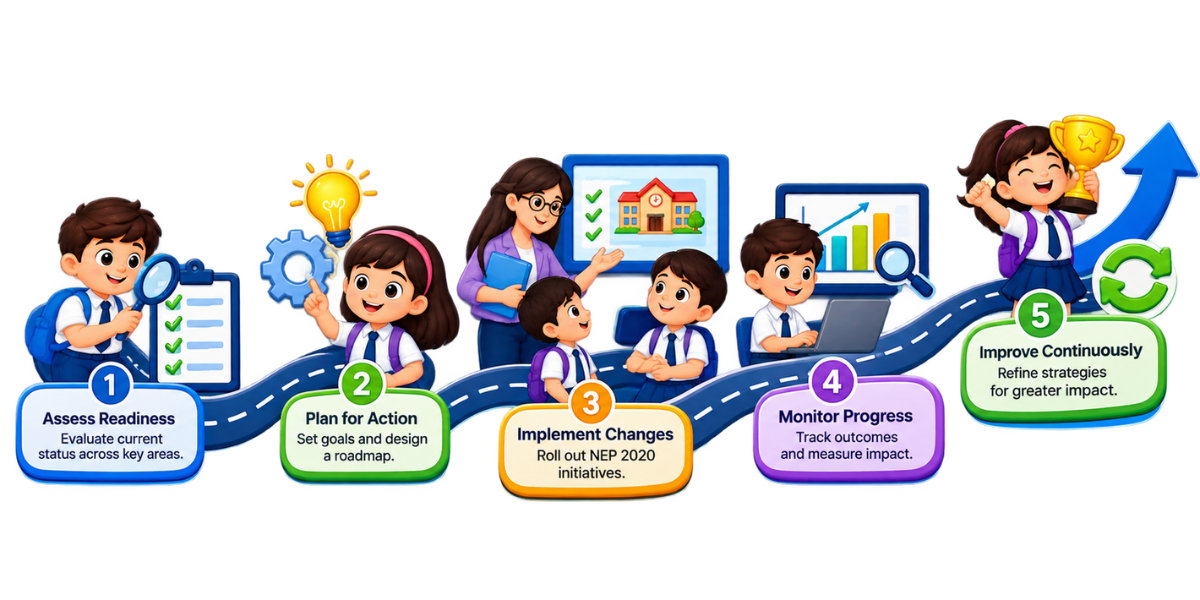
How Can Schools Evaluate Their NEP 2020 Readiness?
After reviewing these 10 areas, schools can classify their preparedness into three levels:
- Ready: Existing practices are established and supported by evidence.
- In Progress: Initiatives have started but require improvement.
- Needs Attention: Important practices or resources are yet to be established.
Based on this assessment, school leaders should create a phased implementation plan, assign responsibilities, provide teacher training and regularly monitor progress.
Explore our NEP 2020 Resources to gain insights, guidance, and practical support for strengthening your school's NEP 2020 readiness.
What Challenges Can Schools Face During NEP 2020 Implementation?
Schools may encounter several challenges while adopting the new education framework, including:
- Limited understanding of NEP 2020 recommendations.
- Insufficient teacher training and professional development.
- Dependence on traditional teaching and examination methods.
- Limited digital infrastructure and learning resources.
- Difficulty introducing vocational and experiential learning.
- Lack of coordination between school management, teachers and parents.
Addressing these challenges requires continuous improvement rather than treating NEP 2020 implementation as a one-time exercise.
Discover our Continuous Development Program to support educators in enhancing their teaching skills and professional growth.
Conclusion
Preparing for NEP 2020 requires more than updating textbooks or introducing digital classrooms. Schools must strengthen curriculum planning, teaching practices, teacher capabilities, assessment methods and learning infrastructure.
This NEP 2020 School Readiness Checklist provides a practical starting point for identifying gaps and prioritising improvements.
TG Gurukul supports school transformation through educational programmes, digital learning resources and teacher development initiatives that help create engaging and future-ready learning environments.
Shape the Future of Your School with TG Gurukul.
Frequently Asked Questions
1. What is an NEP 2020 School Readiness Checklist?
It is a self-assessment tool that helps schools evaluate their preparedness in curriculum, teaching methods, assessment, teacher training, infrastructure, and other key areas recommended under NEP 2020.
2. What are the key areas schools should evaluate?
Schools should review curriculum alignment, experiential learning, assessment, teacher development, foundational literacy and numeracy, inclusion, vocational education, technology, infrastructure and school leadership.
3. How can schools implement NEP 2020 effectively?
Schools can begin by assessing existing practices, identifying gaps, training teachers, developing an implementation roadmap, and regularly monitoring progress.
4. Is teacher training important for NEP 2020 implementation?
Yes. Continuous professional development helps teachers adopt competency-based learning, experiential teaching, inclusive practices, and improved assessment methods.