
A teacher may have a smart classroom, updated textbooks and a detailed lesson plan, yet students may still memorise answers instead of applying what they learn. This highlights a key challenge of school transformation under NEP 2020: meaningful change requires more than new resources. It requires alignment across curriculum, teaching, assessment, teacher capacity and school leadership.
NEP 2020 reshapes school education through the 5+3+3+4 curricular and pedagogical structure for ages 3–18, with greater emphasis on foundational learning, conceptual understanding, skills, multidisciplinary education and holistic development. It also prioritises Early Childhood Care and Education, along with foundational literacy and numeracy. The key question for schools is therefore not just “What is NEP 2020?” but “What needs to change inside our school to turn NEP 2020 into meaningful classroom practice?”
Why Does NEP 2020 Matter for Schools?
NEP 2020 matters for schools because it shifts the focus from rote learning to conceptual understanding, competency development, foundational learning and holistic student development. This requires schools to rethink curriculum, teaching methods, assessment and teacher development—not just introduce new resources.
Consider a student who can define evaporation but struggles to explain why wet clothes dry faster on a sunny, windy day. The gap is between remembering and applying. NEP 2020 encourages schools to bridge this gap through critical thinking, creativity, problem-solving, communication and experiential learning.
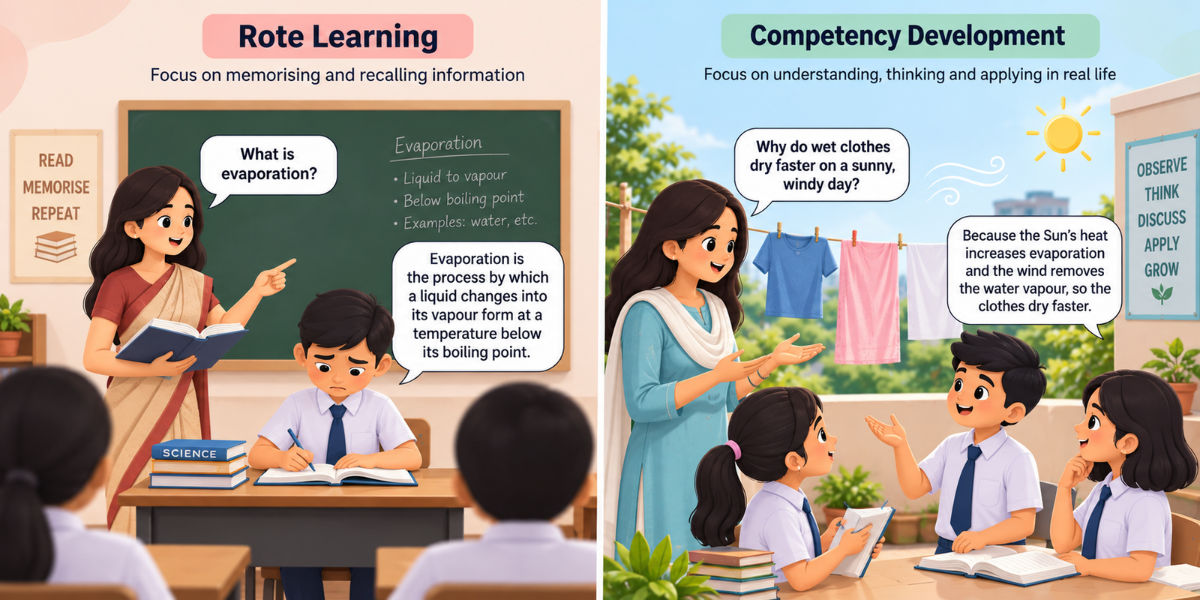
From Rote Learning to Competency Development
Instead of focusing only on completing chapters, memorising definitions and scoring marks, an NEP-aligned classroom asks: “What can students do with what they have learned?” A mathematics lesson on percentages, for example, could involve comparing real-world discounts and explaining which offer provides better value.
Building Future-Ready Learners
Future-ready education is not simply about using more technology. It is about developing critical thinking, problem-solving, communication, creativity, collaboration, decision-making and adaptability. The National Curriculum Framework for School Education 2023 reinforces this focus on conceptual understanding, critical thinking and multidisciplinary learning.
Practical takeaway: Schools should measure NEP implementation by how effectively students understand, apply and demonstrate their learning—not simply by the number of activities or resources introduced.
How Does NEP 2020 Transform the School Education System?
NEP 2020 transforms school education by reorganising schooling into the 5+3+3+4 structure and connecting each stage with developmentally appropriate learning. It also strengthens foundational literacy and numeracy, multidisciplinary education, vocational exposure, multilingualism, experiential learning and holistic development, requiring schools to align curriculum, pedagogy and assessment with these priorities.
The NEP 2020 structure replaces the earlier 10+2 design with four developmental stages covering ages 3–18:
| Stage | Age Group | Broad Learning Direction |
|---|---|---|
| Foundational | 3–8 years | Play, activity, language, early numeracy and foundational learning |
| Preparatory | 8–11 years | Discovery, activity, language and conceptual development |
| Middle | 11–14 years | Subject understanding, experiential learning and skills |
| Secondary | 14–18 years | Deeper learning, flexibility, multidisciplinary choices and preparation for future pathways |
The Ministry of Education describes the 5+3+3+4 model as a curricular and pedagogical restructuring, not merely a change in the classification of classes.
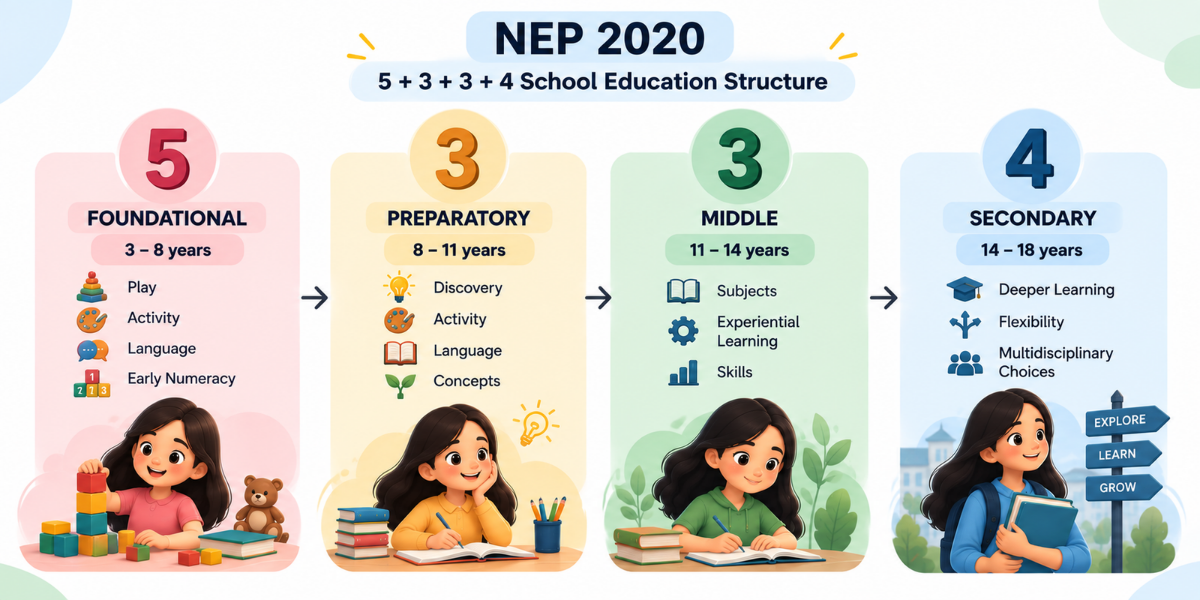
- Understanding the 5+3+3+4 Structure
The Foundational Stage covers three years of Anganwadi, preschool or Balvatika, followed by Classes 1–2. The Preparatory Stage covers Classes 3–5, the Middle Stage Classes 6–8, and the Secondary Stage Classes 9–12. Teaching approaches should be adapted to the developmental needs of each stage rather than treating every grade in the same way.
- Strengthening Foundational Learning
NEP 2020 gives strong importance to Foundational Literacy and Numeracy (FLN) because early reading, writing and numeracy skills support learning across later grades. Schools need appropriate teaching practices, regular monitoring and timely support when students face learning gaps.
- Moving Towards Multidisciplinary Learning
NEP 2020 encourages schools to connect different learning areas instead of keeping subjects completely separate. For example, students can explore community water usage through Science, Mathematics, Geography and Environmental Studies, helping them understand how different areas of knowledge connect.
- Introducing Skill and Vocational Exposure
NEP 2020 aims to integrate vocational education into mainstream schooling. Schools can provide students with opportunities to explore practical activities, local occupations, problem-solving and skill-based experiences alongside academic learning.
What Changes Does NEP 2020 Bring to Curriculum and Teaching?
NEP 2020 encourages schools to reduce unnecessary content load and create greater space for conceptual understanding, critical thinking, inquiry, discussion, experiential learning and application. Teaching therefore moves toward learner-centred and competency-based approaches, while curriculum becomes more multidisciplinary, flexible and connected to real-life contexts.
- From Content Coverage to Competency Development: Focus on what students can understand, apply and demonstrate—not just how much syllabus they complete.
- Focus on Application, Not Just Recall: Connect concepts to real situations. For example, teach percentages through discounts, budgets or savings.
- Encourage Experiential and Inquiry-Based Learning: Let students learn through observing, investigating, experimenting, discussing and reflecting.
- Connect Different Learning Areas: Encourage simple multidisciplinary connections, such as combining history with maps or science with data analysis.
- Make Learning More Learner-Centred: Teachers can act as facilitators by designing activities, asking meaningful questions, providing feedback and addressing different learning needs.
- Align Lesson Planning With Learning Outcomes: Instead of asking only, “Which chapter should I complete?”, teachers can ask, “What should students be able to demonstrate by the end of this lesson?”
- Strengthen Teacher Development: Teachers need ongoing training, collaboration, resources and support to adopt new teaching approaches effectively.
How Does NEP 2020 Transform Assessment in Schools?
NEP 2020 shifts assessment from memorisation toward understanding, competencies and learning progress. Schools are encouraged to use formative, competency-based and holistic assessment to identify what students know, where they struggle and how they can improve.
For example, instead of only asking students to define photosynthesis, an assessment can ask them to explain how limited sunlight affects a plant's ability to produce food. The second question tests application and understanding, not just recall.
From Rote-Based Testing to Competency-Based Assessment
- Focus on Competencies
Assess what students can understand, apply and demonstrate in real-world situations. - Align Teaching and Assessment
Use the cycle: Learning Objective → Teaching → Evidence → Feedback → Improvement. - Use Diverse Assessment Methods
Include application-based questions, projects, presentations, portfolios, demonstrations, observations and formative assessments. - Identify Learning Gaps
Formative assessment can reveal why a student is struggling, allowing teachers to adapt instruction. - Move Towards Holistic Progress
NEP 2020 promotes a broader view of student development beyond marks, supported by assessment reforms and initiatives such as PARAKH.
What Does NEP 2020 Mean for Teachers and School Leadership?
NEP 2020 places teachers at the centre of educational transformation and emphasises professional development, better preparation and supportive working environments. School leaders must translate these priorities into practice by aligning curriculum, assessment, teacher capacity and resources. Since changing classroom practice takes time, teacher readiness and leadership support are critical.
The Changing Role of Teachers
Teachers remain subject experts but increasingly take on the role of facilitators who support inquiry, design learning activities, address different learning needs, use formative assessment, integrate relevant technology and connect concepts to real-life situations. This transition should be phased and supported, rather than implemented overnight.
Why Continuous Professional Development Matters
A single workshop rarely changes classroom practice. Teachers need continuous opportunities to learn, practise, receive feedback, reflect and improve through training, mentoring, peer observation, collaborative planning and reviewing student work. Strong professional development helps teachers confidently adopt NEP-aligned teaching and assessment practices.
The Role of School Leaders
School leaders create the conditions in which classroom transformation can happen.
They can:
- Set clear priorities
Schools should identify which NEP-aligned practices need attention first instead of attempting every reform simultaneously. - Create teacher support systems
Teachers need time for collaborative planning, professional development and reflection. - Align assessment with teaching
If teachers are encouraged to use experiential learning but students are still evaluated primarily through recall-heavy tests, the system sends conflicting signals. - Monitor implementation
Leaders should look beyond whether activities were conducted and examine whether they improved student learning. - Use evidence for improvement
Student work, classroom observations, assessment data and teacher feedback can inform the next implementation cycle.
The Ministry of Education's current school-education reporting also highlights teacher capacity building, competency-based education, experiential pedagogy and skill education as areas connected with NEP implementation.
Conclusion
The real measure of school transformation under NEP 2020 will not be the number of policy documents a school has adopted or the number of new initiatives it has introduced.
It will be visible in the classroom.
A student asking better questions. A teacher using assessment to adjust instruction. A school leader using evidence to support teachers. A curriculum that gives students opportunities to apply knowledge rather than simply reproduce it.
NEP 2020 provides the policy direction. The National Curriculum Framework for School Education 2023 provides an important curriculum framework for translating that direction into school education. NCERT continues to publish implementation resources and advisories for schools.
The next step for schools is therefore not to ask, “Have we implemented NEP 2020?”
It is to ask:
“What has changed in our classrooms because of NEP 2020—and what evidence shows that the change is improving student learning?
Key Takeaways
- NEP 2020 is more than a curriculum reform. It requires schools to align curriculum, teaching, assessment, teacher development and leadership.
- The 5+3+3+4 structure changes how learning is organised. Each stage requires teaching approaches suited to students’ developmental and learning needs.
- Learning needs to move beyond rote memorisation. Schools should give greater attention to conceptual understanding, competency development, application, inquiry and real-world learning.
- Assessment should measure more than recall. Competency-based, formative and holistic approaches can help teachers understand student progress and identify learning gaps.
- Teachers are central to successful implementation. Continuous professional development, collaboration, feedback and leadership support are essential for sustained classroom change.
- School leadership turns policy into practice. Clear priorities, teacher support, aligned assessment and evidence-based monitoring help schools implement NEP 2020 more effectively.
- The real measure of transformation is what happens in the classroom. The focus should be on whether students are understanding, applying and demonstrating their learning—not simply whether schools have introduced new initiatives.
Upcoming Blogs
- Experiential Learning Under NEP 2020: From Rote Learning to Learning by Doing.
- Vocational Education in Schools: Preparing Students for Careers and the Future of Work.
- Future-Ready Schools: How AI, Robotics, Vocational Education & Life Skills Prepare Students for 2030.
- Skill-based learning for classes 6–12: what students should learn beyond textbooks.