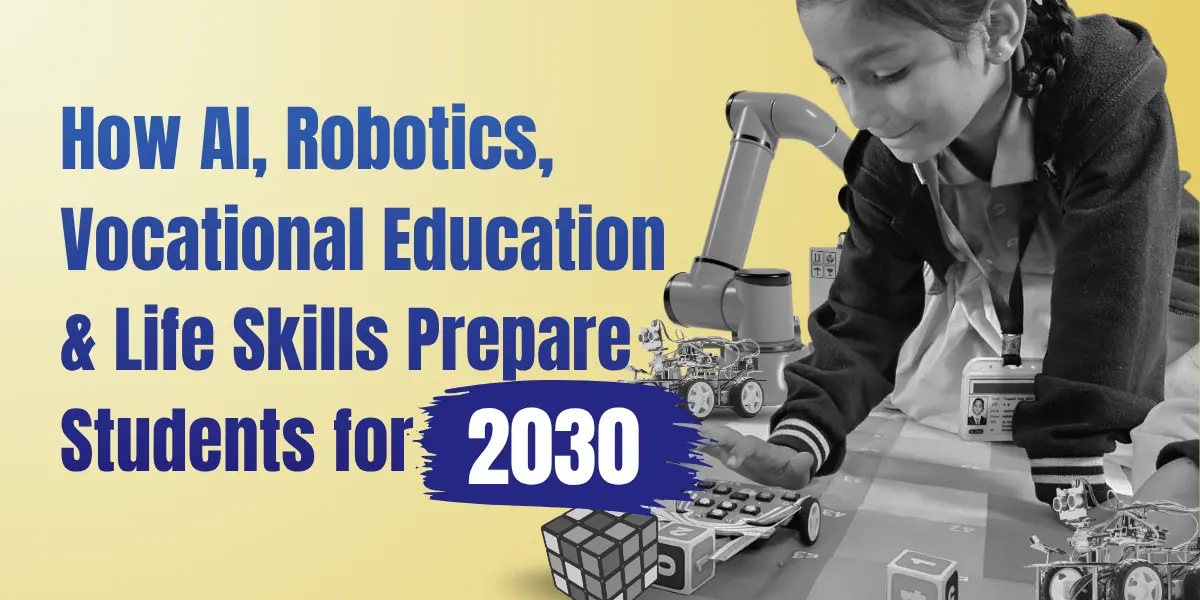
Future-Ready Schools: How AI, Robotics, Vocational Education & Life Skills Prepare Students for 2030
Imagine a classroom where students can explain a scientific concept from their textbook but struggle to apply it to a real-world problem. They may know the formula for calculating area, yet find it difficult to use that knowledge to plan a school garden. They may use digital devices every day without understanding how artificial intelligence (AI) works or how to evaluate information generated by it.
This highlights an important challenge for Indian schools: students need more than academic knowledge to navigate an increasingly complex world. They need opportunities to apply what they learn.
As technology, industries and career pathways evolve, schools must help learners develop practical skills, digital literacy, critical thinking, communication and adaptability alongside foundational academic knowledge. This does not mean replacing traditional subjects with technology. It means connecting classroom learning with the problems students may encounter beyond school.
Future-ready schools take this approach by combining strong academic foundations with AI education, robotics, vocational learning, experiential activities and life skills. The objective is not to predict exactly what the world will look like in 2030. It is to help students build the knowledge, confidence and capabilities to respond to change.
What Is a Future-Ready School?
A future-ready school prepares students to apply academic knowledge, use technology responsibly, solve problems, collaborate with others, and adapt to changing circumstances. It combines foundational learning with practical experiences, digital literacy, vocational exposure, and life skills. A future-ready school is not defined by the number of devices or laboratories it owns, but by how effectively it helps students develop and demonstrate these capabilities.
From Teaching Content to Developing Capabilities
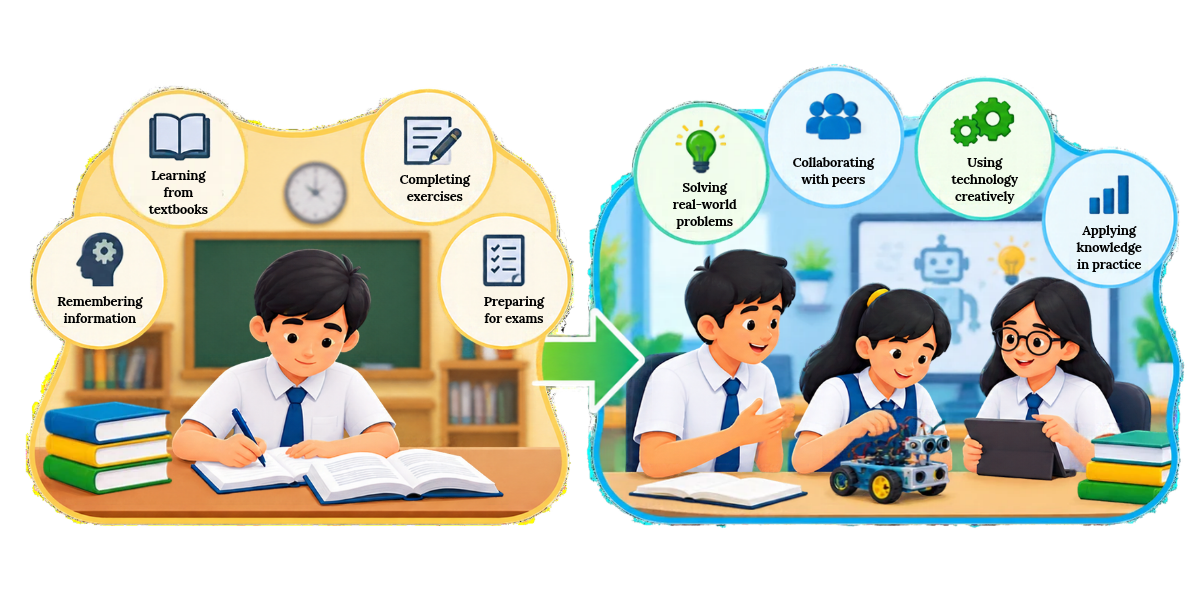
Traditional classroom instruction often focuses on explaining concepts, completing exercises, and preparing students for examinations. These remain important parts of education. However, students also need opportunities to investigate questions, test ideas, make decisions, and learn from mistakes.
Consider a science lesson on water conservation.
Students might learn about the water cycle, calculate water consumption, and answer textbook questions. A future-ready approach extends this learning: students could examine water usage in their school, identify potential wastage, calculate possible savings, and present practical recommendations.
The subject of knowledge remains the foundation. The difference lies in how students use it.
| Traditional Classroom Emphasis | Future-Ready Classroom Emphasis |
|---|---|
| Remembering information | Understanding and applying concepts |
| Completing textbook exercises | Solving problems using subject knowledge |
| Learning about technology | Using and evaluating technology responsibly |
| Studying academic subjects separately | Connecting concepts across subjects |
| Measuring progress mainly through marks | Combining academic results with evidence of practical skills |
| Preparing for a specific examination | Building foundations for lifelong learning |
The key distinction is implementation. Technology, projects, and activities contribute to future readiness when they support clear learning objectives—not simply because they are new or engaging.
Why Do Students Need Future-Ready Skills by 2030?
Students need future-ready skills because technological change, evolving workplace requirements, and complex social challenges are changing how people learn, work, and make decisions. Academic knowledge remains essential, but learners also need digital literacy, problem-solving, collaboration, creativity, and adaptability. Developing these capabilities during school helps students approach unfamiliar situations with greater confidence and continue learning as requirements change.
The Skills Students Need Are Changing
The World Economic Forum's Future of Jobs Report 2025 projects substantial changes in the global employment landscape by 2030. Its analysis estimates that 39% of workers' existing skill sets may be transformed or become outdated during the 2025–2030 period.
The report also highlights growing demand for technological capabilities alongside skills such as creative thinking, resilience, and flexibility. These are global projections based on employer research and modelling, not guarantees about individual careers or the Indian job market.
For schools, the important lesson is not that every student must become a programmer or AI specialist.
Students need the ability to learn new things, evaluate information, apply knowledge, and respond constructively to unfamiliar challenges.
What Does This Mean for School Education?
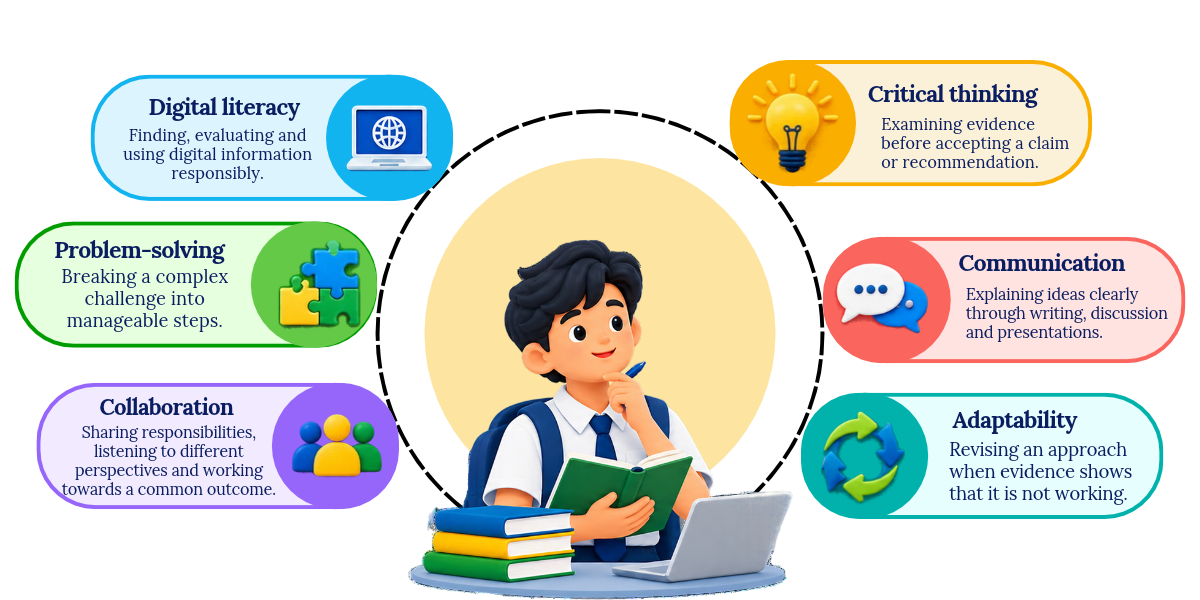
Future-ready learning should help students develop capabilities that transfer across subjects and situations.
For example:
- Digital literacy: Finding, evaluating and using digital information responsibly.
- Critical thinking: Examining evidence before accepting a claim or recommendation.
- Problem-solving: Breaking a complex challenge into manageable steps.
- Communication: Explaining ideas clearly through writing, discussion and presentations.
- Collaboration: Sharing responsibilities, listening to different perspectives and working towards a common outcome.
- Adaptability: Revising an approach when evidence shows that it is not working.
These skills are not separate from academic learning. They become stronger when students practise them while learning mathematics, science, languages, social sciences and other subjects.
How Does NEP 2020 Support Future-Ready Education?
India's National Education Policy (NEP) 2020 provides a policy foundation for future-ready education by emphasizing scientific thinking, creativity, communication, teamwork, problem-solving, digital literacy, coding, computational thinking and vocational exposure. It also calls for the introduction of contemporary subjects, including artificial intelligence, at relevant stages. The policy's direction is clear: school education should develop a broader range of capabilities alongside academic knowledge.
Moving Beyond Rote Learning
NEP 2020 identifies a range of skills and capacities that students should develop to become adaptable, innovative, and productive individuals. These include evidence-based thinking, creativity, communication, collaboration, logical reasoning, digital literacy, ethical reasoning, and environmental awareness.
The policy also highlights experiential learning and the integration of vocational education into mainstream education.
For schools, this creates an important implementation question:
How can policy objectives become part of everyday classroom practice?
A school does not necessarily need to introduce a separate subject for every skill. Teachers can integrate many of these capabilities into existing lessons.
For example, a mathematics teacher can develop problem-solving through real-world calculations. A science teacher can encourage evidence-based thinking through experiments. A language teacher can strengthen communication through structured discussions and presentations.
Similarly, a group project can combine subject knowledge, collaboration, research and decision-making.
Translating Policy into Practice
| NEP 2020 Priority | Possible Classroom Application |
|---|---|
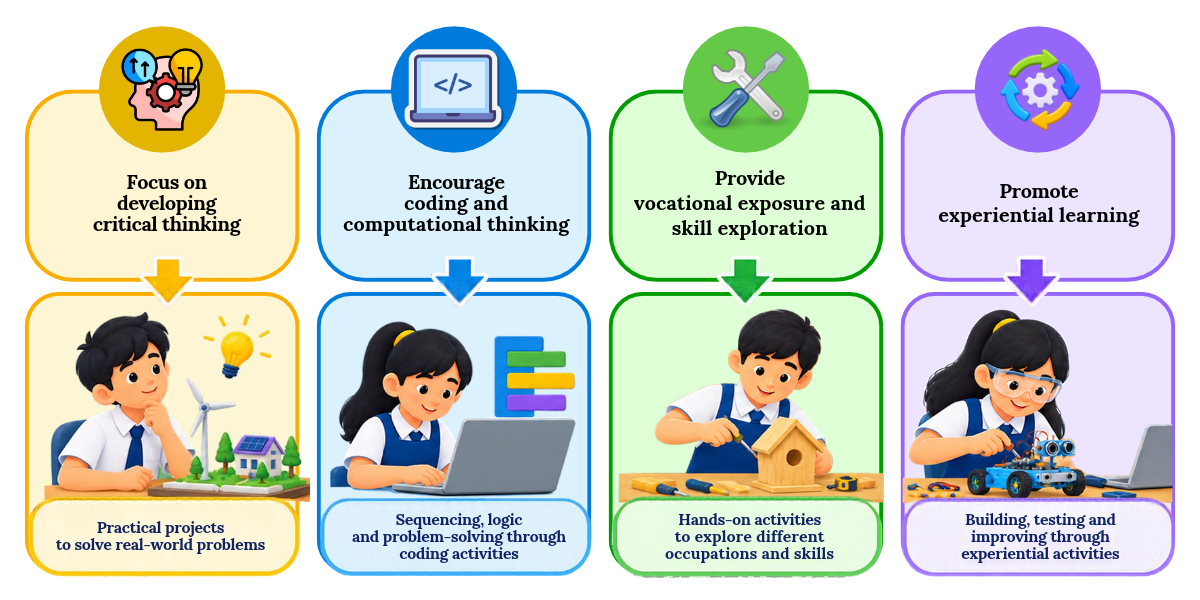
| Critical thinking and problem-solving | Investigating a local environmental or community problem |
| Coding and computational thinking | Sequencing instructions and creating age-appropriate coding activities |
| Contemporary subjects such as AI | Exploring how AI systems recognise patterns and where they can make mistakes |
| Vocational exposure | Learning practical skills and exploring different occupations |
| Experiential learning | Conducting experiments, building prototypes and reflecting on results |
| Communication and collaboration | Group projects, presentations and peer discussions |
| Ethical and environmental awareness | Evaluating the social and environmental consequences of decisions |
Policy alignment alone does not guarantee classroom transformation. Schools need appropriate teaching resources, teacher preparation, time for practical learning, and ways to assess whether students are developing the intended skills.
How Does AI Education Prepare Students for the Future?
AI education prepares students to understand how artificial intelligence works at a foundational level, use AI tools responsibly, and evaluate their outputs critically. It should develop more than familiarity with AI applications. Students need to question information, recognize possible bias, protect personal data, and understand that AI-generated responses can be inaccurate. Age-appropriate AI education helps learners become informed users of technology rather than passive consumers of it.
AI Literacy Is More Than Using an AI Tool
A student who uses an AI application to generate an answer is not necessarily learning how AI works.
Meaningful AI education helps students understand the relationship between data, patterns and outputs. It also encourages them to question whether an AI-generated answer is reliable, fair and appropriate for the task.
UNESCO's AI Competency Framework for Students identifies 12 competencies across four dimensions: a human-centred mindset, ethics of AI, AI techniques and applications, and AI system design. Its framework progresses from understanding AI to applying knowledge and creating AI solutions.
Schools can use these principles to introduce AI learning progressively.
How Can Teachers Introduce AI Education?
Start with familiar examples. Students can explore how recommendation systems suggest videos, how voice assistants interpret requests or how image-recognition tools identify objects.
Teachers can then guide students through questions such as:
- What information might this system use?
- Could it produce an incorrect answer?
- What happens if the information used to train a system is incomplete or biased?
- Which decisions should remain under human judgement?
- What personal information should never be shared with an AI tool?
These questions develop digital awareness and critical thinking without requiring every student to learn advanced programming.
Classroom Example: Can AI Identify Local Waste Correctly?
A teacher could ask students to investigate waste segregation in their school. Students first learn the difference between recyclable, biodegradable and non-recyclable materials. They then examine how an image-recognition tool might classify different waste items.
Students compare the tool's predictions with their own observations, identify mistakes and discuss why context matters.
The learning objective is not simply to demonstrate AI. It is to understand classification, evaluate the quality of a prediction, and recognize the importance of human verification.
Responsible AI use must remain central to the lesson. Schools should follow appropriate age-related safeguards, protect student information, and check the terms and privacy practices of any tool used.
How Does Robotics Education Develop Practical Skills?
Robotics education helps students connect science, technology, engineering and mathematics through hands-on design, construction, coding, and testing. By working with components such as sensors, motors, and controllers, students can investigate how systems respond to instructions and their surroundings. The educational value comes from the complete process: identifying a problem, designing a solution, testing it, analyzing failures, and improving the result.
Learning Through Building and Testing
Reading about a machine explains how it is supposed to work. Building a simple model allows students to discover what happens when its components do not work as expected.
A robotics activity may involve:
- Identifying a problem the robot should solve.
- Planning the design and selecting suitable components.
- Developing a sequence of instructions.
- Building and testing the model.
- Recording errors and identifying possible causes.
- Modifying the design and evaluating the improvement.
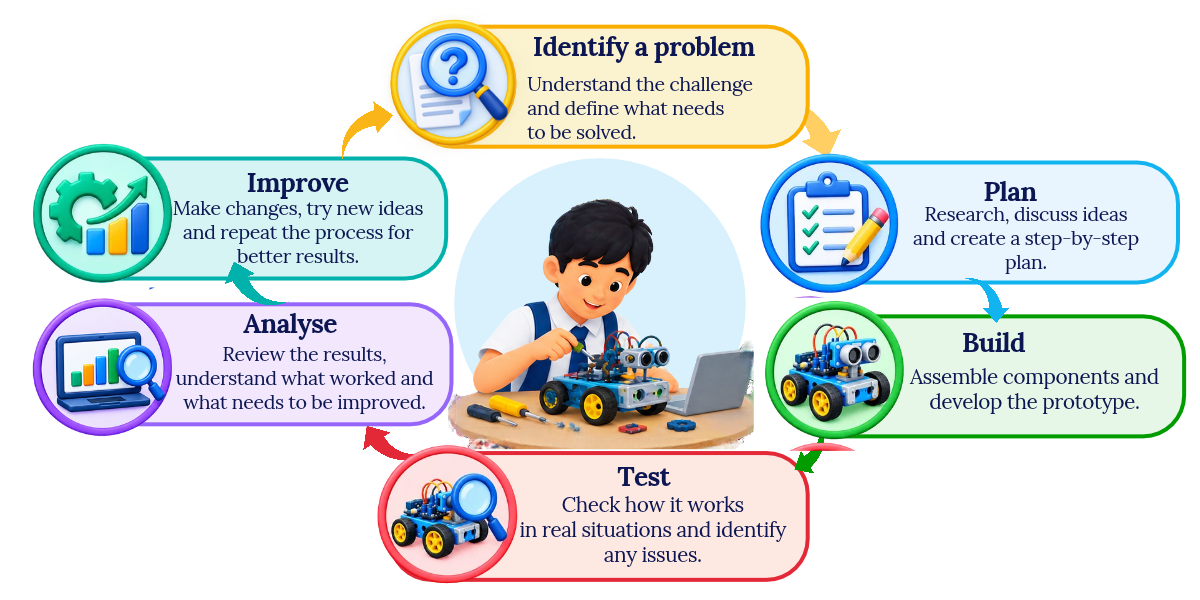
Each stage develops a different capability. Students practice logical reasoning when creating instructions, mathematical thinking when measuring or comparing results, and collaboration when dividing project responsibilities. They also learn that failure can provide useful information.
Classroom Example: Build a Simple Obstacle-Detection Robot
Students can work in small groups to design a robot that detects an obstacle and changes direction.
The activity can introduce sensors, programming logic, measurement, and cause-and-effect relationships. Students can test the robot at different distances, record its performance, and adjust the instructions.
Teachers can connect the project to physics, mathematics, and technology while asking students to explain why particular changes improved or reduced performance.
Not every school needs an advanced robotics laboratory to begin this kind of learning. Age-appropriate activities can start with unplugged sequencing exercises, paper prototypes or basic programmable devices, depending on available resources.
However, a robotics kit alone does not create meaningful learning. Teachers need a clear learning objective, structured activities, and opportunities for students to explain their decisions.
Why Is Vocational Education Important in Schools?
Vocational education helps students connect classroom learning with practical skills, occupational knowledge, and potential career pathways. It complements academic education by allowing learners to explore how knowledge is applied in different fields, from agriculture and healthcare to technology, business, and skilled trades. When introduced progressively, vocational learning can strengthen confidence, career awareness, and practical problem-solving without limiting students to a single future occupation.
Breaking the Divide Between Academic and Practical Learning
Vocational education is sometimes treated as an alternative for students who are not interested in academic subjects. This perception overlooks its wider educational value.
Every student can benefit from understanding how work is organized, how services are delivered, how products are made, and how practical decisions are taken.
NEP 2020 calls for vocational exposure from the middle and secondary school years and for vocational education to be integrated into mainstream education in a phased manner. It also emphasizes the dignity of labor and the importance of connecting vocational capacities with academic learning.
The Government of India's Samagra Shiksha vocational education program describes vocational education as an integrated part of school education, with exposure activities for middle-school students and vocational courses for secondary and senior-secondary learners in participating schools.
What Can Vocational Learning Look Like in Schools?
Schools can introduce age-appropriate practical experiences connected to local needs and available resources.
Examples include:
- Agriculture: Understanding soil, growing plants, and exploring water-efficient cultivation.
- Financial literacy: Preparing a simple budget, comparing prices, and understanding saving.
- Digital skills: Creating presentations, managing information, and learning basic digital workflows.
- Entrepreneurship: Identifying a community's needs and developing a simple product or service proposal.
- Environmental skills: Conducting waste audits, practicing segregation and planning resource conservation.
- Local crafts and trades: Learning about materials, processes, safety and the skills involved in local occupations.
These activities should involve guided practice, reflection, and feedback—not just demonstrations or one-time events.
Connecting Vocational Education with Academic Subjects
A school garden can become a practical learning environment.
Students apply mathematics to calculate the area of a plot, science to understand plant growth, environmental studies to explore water conservation, and communication skills to present their findings. Teachers can also introduce basic budgeting and discuss occupations connected with agriculture and horticulture.
This approach helps students see how different subjects contribute to solving a real problem.
Vocational education should expand students' choices, not narrow them. Career exploration at school should help learners discover interests and understand possibilities while keeping pathways to further education open.
Which Life Skills Do Students Need to Succeed in 2030?
Students need life skills that help them manage information, relationships, decisions, and change. Critical thinking, communication, collaboration, creativity, adaptability, financial literacy, self-management and responsible digital behaviour are particularly relevant to learning and everyday life. These capabilities develop through repeated practice, feedback, and reflection. Schools can strengthen them by embedding meaningful responsibilities and real-world challenges into ordinary classroom activities.
The Essential Life Skills for Future-Ready Students
| Life Skill | Why It Matters | Classroom Activity | What Teachers Can Observe |
|---|---|---|---|
| Critical thinking | Helps students evaluate information and evidence | Compare two explanations of the same issue | Student identifies evidence and questions unsupported claims |
| Problem-solving | Helps learners approach unfamiliar challenges systematically | Investigate a school resource-use problem | Student identifies causes and proposes practical solutions |
| Communication | Supports clear expression and understanding | Present project findings to classmates | Student explains ideas clearly and responds to questions |
| Collaboration | Builds the ability to work with different people | Complete a group project with assigned responsibilities | Student listens, contributes and shares tasks |
| Creativity | Encourages new ideas and alternative approaches | Design more than one solution to a classroom challenge | Student explores alternatives and explains design choices |
| Adaptability | Helps students respond when circumstances change | Revise a project after testing reveals a problem | Student uses feedback to improve the approach |
| Financial literacy | Supports informed everyday financial decisions | Compare prices and prepare a simple budget | Student calculates costs and explains spending choices |
| Self-management | Supports responsibility and independent learning | Plan a project with milestones and deadlines | Student tracks progress and completes agreed tasks |
| Digital responsibility | Encourages safe and ethical technology use | Evaluate an online claim or discuss digital privacy | Student checks sources and identifies privacy risks |
Life Skills Must Be Practised, Not Just Discussed
A lesson explaining teamwork cannot, by itself, establish that students can work effectively in a group.
Students need repeated opportunities to plan together, divide responsibilities, resolve disagreements, and reflect on their contributions. Teachers can make these experiences more effective by setting clear expectations and providing specific feedback.
For example, after a group project, students could answer three questions:
- What did our team do well?
- What problem slowed us down, and how did we respond?
- What would we change in our next project?
This reflection helps students recognize their own behaviour and identify areas for improvement.
Life skills should also be developed through the school's wider environment. Classroom discussions, sports, student leadership, clubs, peer learning and community activities can all provide opportunities to practice responsibility and communication.
How Do AI, Robotics, Vocational Education and Life Skills Work Together?
AI, robotics, vocational education and life skills become more valuable when students use them together to solve a meaningful problem. An integrated project can connect academic knowledge with technology, practical application, teamwork, and decision-making. Rather than teaching each area in isolation, schools can create learning experiences in which students investigate a problem, design a response, test their ideas, and explain the results.
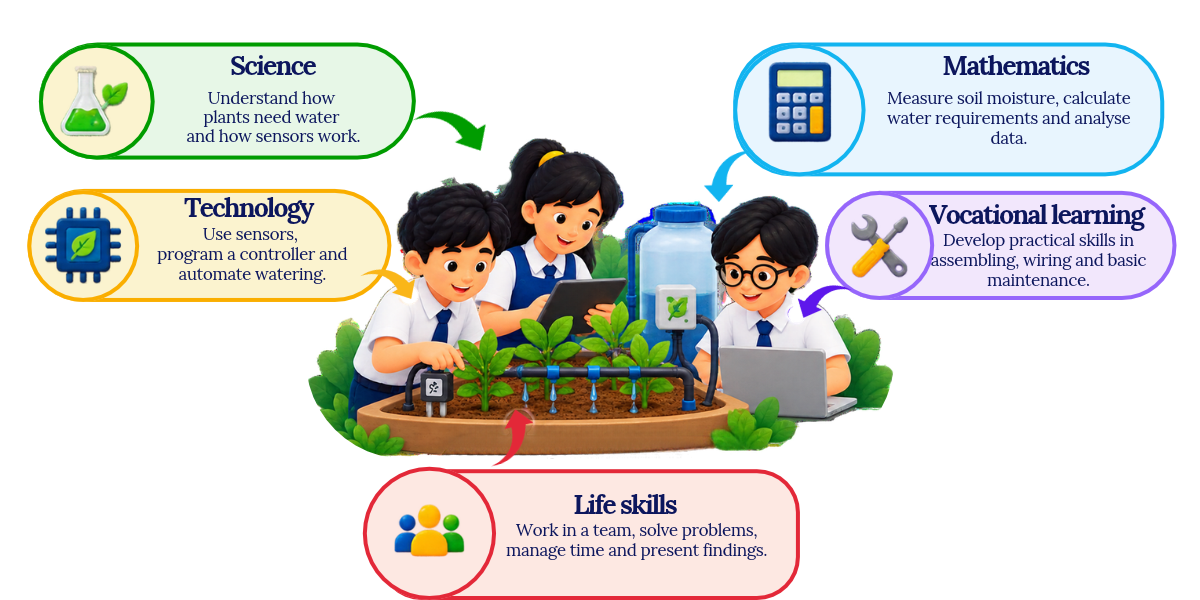
Integrated Classroom Example: A Smart Irrigation Project
Consider a school that wants to reduce unnecessary water use in its garden.
Instead of treating science, mathematics, technology, and vocational learning as separate activities, teachers can organise a project around the school's actual needs.
Step 1: Understand the problem
Students observe the garden, investigate plant-water requirements, and measure the area that needs watering. They record their observations and estimate how much water is used.
Skills developed: Scientific observation, measurement, data collection, and critical thinking.
Step 2: Explore the technology
Students learn how soil-moisture sensors work and how a controller can respond to sensor readings. If appropriate equipment is available, they can create a simple system that activates watering when the soil reaches a specified moisture level.
They can also discuss how data might be collected and used to improve decisions.
Skills developed: Digital literacy, engineering design, logical reasoning, and basic automation.
Step 3: Connect the project to vocational learning
Students explore irrigation methods, gardening practices, and the work involved in maintaining green spaces. They can investigate water conservation practices used in agriculture and horticulture.
Skills developed: Practical problem-solving, occupational awareness, and environmental responsibility.
Step 4: Practice life skills
Students divide responsibilities, document their work, discuss disagreements, and present their findings to the school community. They compare the proposed system with the school's existing watering method.
Skills developed: Collaboration, communication, decision-making, and adaptability.
Step 5: Evaluate the outcome
Students compare water-use observations before and after the intervention, where reliable measurements are possible. They identify limitations and recommend further improvements.
The project now connects classroom learning with a practical school challenge.
An important distinction: A sensor-based irrigation system is not automatically an AI system. If the project uses fixed rules—for example, switching on a pump when soil moisture falls below a threshold—it demonstrates sensing and automation.
AI should be introduced only when the project actually uses an AI method, such as a model trained to predict watering needs from relevant data.
This distinction helps students understand technology accurately rather than treating every automated device as artificial intelligence.
How Can Schools Build a Future-Ready Learning Ecosystem?
Schools can build a future-ready learning ecosystem by identifying the capabilities students need, connecting them to existing subjects, planning practical activities, preparing teachers, and assessing student progress. The process does not have to begin with a large infrastructure investment. Schools can start with curriculum-linked projects and available resources, then expand their programs as teacher capacity, facilities and implementation experience develop.
The Future-Ready School Implementation Framework
The following Future-Ready School Implementation Framework is a practical planning model for school leaders and educators. It is a proposed framework for organizing implementation, not a formally validated assessment instrument.
| Stage | What Schools Should Do | Practical Action | Evidence of Progress |
|---|---|---|---|
| 1. Identify | Determine the skills students need to develop | Select a small set of priorities, such as problem-solving, digital literacy and communication | A clear list of student competencies |
| 2. Align | Connect skills with curriculum objectives | Map each competency to relevant subjects and learning outcomes | A curriculum-linked activity plan |
| 3. Design | Create practical, age-appropriate learning experiences | Plan a project, experiment, vocational activity or technology task | Written activity instructions and assessment criteria |
| 4. Prepare | Build teacher confidence and readiness | Provide demonstrations, collaborative planning and professional development | Teachers can explain and facilitate the planned activity |
| 5. Implement | Run the activities using available resources | Begin with a manageable project and assign clear responsibilities | Student participation and completed work |
| 6. Assess | Examine what students can demonstrate | Use observation, project rubrics, presentations and student reflection | Evidence of knowledge application and skill development |
| 7. Improve | Use feedback to strengthen the next cycle | Identify learning gaps and revise activities or teaching approaches | Documented changes based on assessment findings |
How Can Government Schools Begin with Limited Resources?
A school does not need to introduce every component at once. A practical starting point is to identify one local challenge and build a curriculum-linked activity around it.
For example, students could conduct a classroom energy audit, examine water use, create a waste-segregation plan or develop a simple solution to improve classroom organisation.
These activities can build scientific thinking, mathematics, communication, collaboration and environmental awareness without requiring an advanced laboratory.
Schools can then introduce more specialised AI, coding and robotics activities according to curriculum requirements, available infrastructure, teacher readiness, and student needs.
What Should School Leaders Prioritize?
Start with learning objectives, not equipment.
Before purchasing devices or establishing a laboratory, school leaders should ask:
- Which student competencies should this investment develop?
- How will teachers integrate the resources into classroom learning?
- What training and ongoing support will teachers require?
- How frequently will students use the resources?
- How will the school assess whether learning objectives are being achieved?
- Can the model be sustained and adapted to the school's circumstances?
This planning helps schools avoid investing in equipment that is rarely used or disconnected from the curriculum.
The Role of Teacher Development
Teachers are central to implementation. They need the confidence to facilitate inquiry, guide projects, manage group activities and assess skills that may not be captured by conventional examinations alone.
Professional development should therefore combine subject knowledge, practical demonstrations, lesson planning, classroom application, and reflection.
TG Gurukul supports teacher development through its Continuous Professional Development programme, which focuses on strengthening teacher capacity through modern pedagogy, technology integration, competency-based teaching and assessment practices.
The objective is to help teachers translate educational priorities into classroom experiences they can plan, facilitate and improve.
What Common Mistakes Should Schools Avoid When Building Future-Ready Classrooms?
Schools can weaken future-ready education when they focus on technology or activities without defining what students should learn. Effective implementation requires clear objectives, teacher preparation, regular practice and evidence of learning.
Common Mistakes and How Schools Can Avoid Them
1. Treating Technology as the Learning Objective
The problem: Schools introduce tablets, robotics kits or AI tools without clear learning goals.
What to do instead: Define the learning objective first and select tools that support it.
2. Organising One-Time Activities Without Follow-Up
The problem: Students attend workshops or demonstrations but get little opportunity to practise.
What to do instead: Plan activities that allow students to revisit concepts, apply learning and improve through feedback.
3. Separating Vocational Education from Academic Learning
The problem: Practical learning is disconnected from subjects such as mathematics and science.
What to do instead: Connect vocational activities with curriculum objectives and real-world applications.
4. Introducing Advanced Technical Skills Too Early
The problem: Schools prioritise complex coding or AI before students develop foundational digital literacy and problem-solving skills.
What to do instead: Introduce skills progressively through age-appropriate activities.
5. Measuring Success Through Participation Alone
The problem: Schools count activities, enrolments or devices without assessing student learning.
What to do instead: Evaluate student work, practical demonstrations and progress against clear criteria.
6. Overlooking Teacher Readiness and Inclusion
The problem: Teachers lack preparation or activities do not accommodate different student needs.
What to do instead: Provide practical training, ongoing support and accessible learning opportunities.
Future-ready education is not a collection of separate initiatives. It is a sustained approach to improving what students learn, how they learn and how they demonstrate their capabilities.
How Can Schools Measure Future-Ready Skills?
Schools can assess future-ready skills through projects, practical demonstrations, presentations, portfolios, observation and reflection. These methods show how students apply knowledge, solve problems, communicate and collaborate.
| Assessment Method | What It Measures | Example |
|---|---|---|
| Project assessment | Application and problem-solving | Designing a water-conservation solution |
| Practical demonstration | Ability to perform a task | Assembling and testing a circuit |
| Presentation | Communication and understanding | Explaining project findings |
| Portfolio | Progress over time | Recording designs, feedback and revisions |
| Observation rubric | Collaboration and self-management | Observing how students share tasks |
| Self-reflection | Awareness of learning | Identifying what they learned and would improve |
| Peer feedback | Constructive evaluation | Reviewing another group's project |
What Should an Assessment Rubric Include?
A simple rubric can use four levels—Beginning, Developing, Proficient and Advanced—to assess observable performance.
For a problem-solving activity, criteria may include:
- Identifying the problem.
- Selecting relevant information.
- Explaining and testing a solution.
- Revising the approach based on evidence.
- Communicating the outcome.
Teachers should explain criteria before activities and provide specific feedback. A single observation should not define a student's ability; skills develop over time and across different contexts.
The purpose of assessment is to guide teaching, support students and make learning progress visible.
What Challenges Do Schools Face When Preparing Students for 2030?
Schools may face limited infrastructure, uneven digital access, curriculum pressures, teacher training needs and difficulties assessing practical skills. These challenges require realistic planning and a phased approach.
| Challenge | Practical Response |
|---|---|
| Limited devices or connectivity | Use shared devices, offline activities and small-group rotations |
| Teacher readiness | Provide hands-on training, mentoring and collaborative planning |
| Curriculum pressure | Integrate projects into existing subjects and learning outcomes |
| Unequal student access | Offer differentiated activities that do not depend on personal device ownership |
| Limited practical resources | Begin with locally available materials and expand gradually |
| Assessment difficulties | Use rubrics, observations, portfolios and feedback |
| Responsible technology use | Establish age-appropriate safeguards and review digital tools |
| Sustainability | Assign responsibilities and plan for maintenance and continued support |
A Realistic Approach to School Transformation
Schools do not need to introduce every initiative at once. They can begin by identifying learning priorities, preparing teachers, using available resources and evaluating student progress before expanding programmes.
Government schools may also explore resource-sharing arrangements and education-focused partnerships aligned with their objectives, accessibility requirements and implementation capacity.
The goal is not to make every school identical. It is to ensure that students have meaningful opportunities to develop the capabilities they will need.
Conclusion: Preparing Students for a Changing World
The future of education is not defined by how quickly schools adopt new technologies. It is defined by how effectively they prepare students to apply knowledge, solve problems, think critically and adapt to changing circumstances.
AI education, robotics, vocational learning and life skills each contribute to this goal. When integrated into everyday classroom practice, they help students connect academic concepts with real-world challenges, explore different career pathways and develop the confidence to learn independently.
For schools, the journey towards becoming future-ready begins with practical steps: aligning learning with NEP 2020, strengthening teacher capabilities, introducing experiential activities and assessing students on how well they apply what they learn.
Progress does not require every school to begin with advanced infrastructure. It requires a clear vision, consistent implementation and a commitment to continuous improvement.
A future-ready school does more than prepare students for their next examination. It equips them with the knowledge, skills and mindset to navigate the opportunities and challenges of 2030 and beyond.
TG Gurukul supports this journey through NEP-aligned programmes, AI and robotics labs, vocational education, teacher development and digital assessment solutions that help schools translate educational priorities into meaningful learning experiences.
Key Takeaways: Building Future-Ready Schools for 2030
Preparing students for 2030 requires more than introducing new technologies or adding activities to an already crowded timetable. Schools need a clear approach to connecting academic learning with practical application, responsible technology use and the development of transferable skills.
The priorities are straightforward:
- Strengthen academic foundations: Students need subject knowledge to evaluate information and solve unfamiliar problems.
- Integrate AI and robotics meaningfully: Technology should support defined learning objectives, critical thinking and responsible use.
- Make vocational learning part of school education: Practical experiences help students understand occupations and apply knowledge beyond textbooks.
- Develop life skills through practice: Communication, collaboration, adaptability and decision-making grow through repeated experiences and feedback.
- Prepare teachers for implementation: Training, resources and ongoing support help translate educational priorities into classroom practice.
- Assess application, not just recall: Projects, demonstrations, portfolios and observation can reveal how students use what they learn.
- Start with realistic goals: Schools can build momentum through manageable, curriculum-linked activities before expanding their programmes.
From Educational Policy to Classroom Practice
NEP 2020 provides an important direction for developing well-rounded learners. Turning that vision into meaningful educational experiences requires consistent planning, teacher capacity building, appropriate resources and evidence-based improvement.
For school leaders, the next step is to identify the capabilities students need to develop and determine how those capabilities can be practised, assessed and strengthened within the existing learning environment.
By combining academic rigour with practical learning, responsible technology use and life skills, schools can build learning environments that respond to students' needs today while helping them prepare for tomorrow.
The measure of a future-ready school is not how many new technologies it introduces. It is how effectively students learn to use knowledge, develop practical capabilities and respond to the challenges they encounter.