Why Indian Classrooms Need to Move Beyond Rote Learning
A student may memorise the formula for calculating the area of a rectangle and reproduce it correctly in an examination. But can the student use that formula to calculate the area of a classroom floor or determine how much material is needed to cover a table?
This difference highlights a central challenge in school education: knowing a concept is not the same as being able to apply it.
Traditional classroom practices often place considerable emphasis on memorisation, textbook completion and examination performance. Although these have a role in learning, students also need opportunities to question, investigate, experiment and apply what they learn.
The National Education Policy (NEP) 2020 addresses this need by calling for a shift away from rote learning towards conceptual understanding, critical thinking and experiential learning. It encourages interactive teaching, hands-on activities, arts-integrated education, sports-integrated learning, and exploration across subjects.
For schools, the challenge is to translate this policy direction into everyday classroom practice.
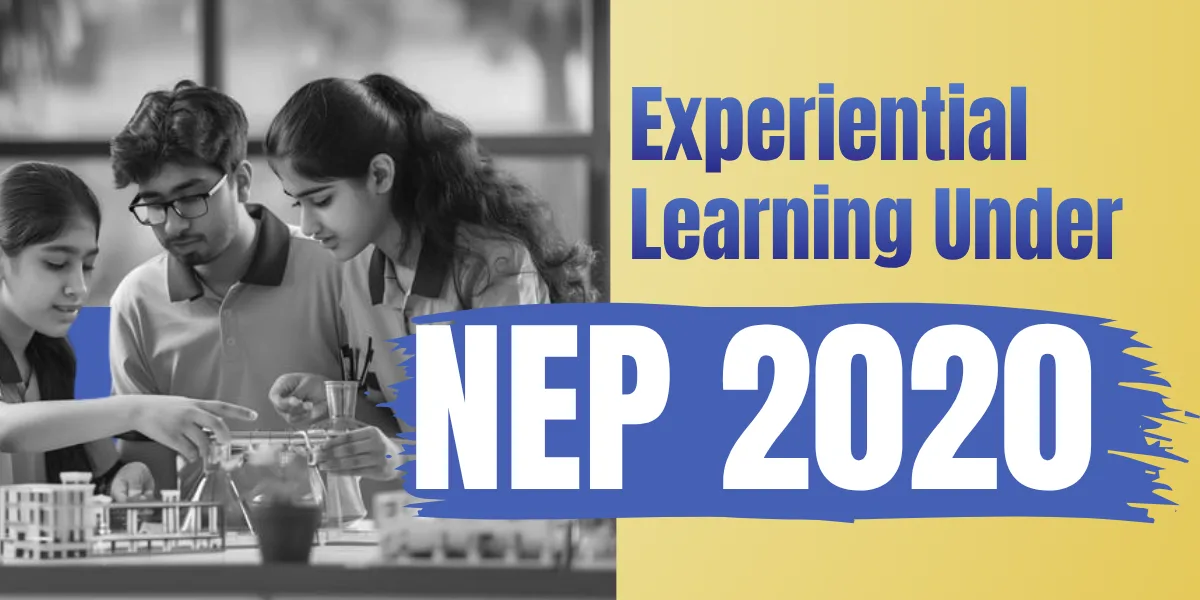
This is where experiential learning under NEP 2020 becomes important. It helps teachers connect concepts with real-world experiences, making learning more meaningful and giving students opportunities to demonstrate what they understand.
The question is no longer simply whether students have completed a lesson. It is whether they can explain the concept, use it in a different situation and demonstrate the competencies they are expected to develop.
What Is Experiential Learning?
Experiential learning is an approach in which students develop understanding through experiences, active participation, reflection and the application of knowledge. Instead of only receiving information, learners investigate problems, test ideas, observe outcomes and connect their experiences with concepts.
Learning by doing, becomes meaningful when students understand what they did, why it worked, and how to apply what they learned elsewhere.
For example, a teacher introducing fractions to Grade 5 students can use paper circles rather than relying only on textbook diagrams.
- Experience: Students divide paper circles into equal parts.
- Reflection: They compare the pieces and discuss why equal parts matter.
- Conceptual understanding: They connect the activity to numerators, denominators, and equivalent fractions.
- Application: They use fractions to solve a problem involving a recipe or the sharing of food.
The activity provides experience. The discussion develops understanding, while the follow-up problem tests whether students can apply the concept.
How Does Experiential Learning Work?
A useful way to understand experiential learning is through four connected stages adapted from David Kolb's experiential learning cycle.
1. Experience
- Students participate in an activity, investigation, or real-world task.
- Example: Divide paper shapes into equal parts to explore fractions.
2. Reflect
- Students observe the results, compare findings, and discuss what happened.
- Example: Explain why unequal pieces cannot represent equal fractions.
3. Connect
- Students relate their observations to a formal concept or principle.
- Example: Connect the paper shapes to numerators, denominators, and equivalent fractions.
4. Apply
- Students use what they have learned to solve a new problem.
- Example: Compare fractions in a recipe or divide a measured quantity into equal portions.
This four-stage cycle is a practical planning aid, not a compulsory sequence prescribed by NEP 2020. Teachers can adapt it to the subject, age group, learning objectives and available resources.
The key distinction: Completing an activity demonstrates participation. Explaining the concept and applying it to a new situation provides stronger evidence of learning.
What Does NEP 2020 Say About Experiential Learning?
NEP 2020 identifies experiential learning as an important part of curriculum and pedagogy reform across school education. Its objective is to move learning towards conceptual understanding, exploration and the development of competencies rather than an excessive dependence on rote memorisation.
Section 4 of the policy discusses holistic development and experiential learning, providing a foundation for schools to rethink how teaching and assessment are organised.
Key NEP 2020 Provisions Related to Experiential Learning
- Paragraph 4.4 — Moving beyond rote learning: Emphasises real understanding, learning how to learn, interactive classrooms, questioning, creativity, collaboration and exploratory activities.
- Paragraph 4.6 — Experiential learning across subjects: Calls for hands-on learning, arts-integrated education, sports-integrated education and storytelling-based pedagogy as standard approaches across stages and subjects. It also links classroom practice to competency-based learning and aligned assessment.
- Paragraph 4.7 — Art-integrated education: Describes the use of art and culture to teach concepts across subjects and strengthen the connection between education and culture.
- Paragraph 4.8 — Sports-integrated education: Highlights the role of physical activities and sports in developing collaboration, initiative, self-discipline, teamwork and responsibility.
How Does the NEP 2020 Structure Support Experiential Learning?
The NEP 2020 Structure follows a 5+3+3+4 curricular and pedagogical design, covering ages 3–18 through four stages.
| Stage | Age group | Experiential learning opportunities |
|---|---|---|
| Foundational Stage | 3–8 years | Play, stories, toys, exploration, conversation and sensory activities |
| Preparatory Stage | 8–11 years | Simple experiments, projects, group tasks, art and activity-based learning |
| Middle Stage | 11–14 years | Subject-based investigations, practical projects, problem-solving and introductory vocational exposure |
| Secondary Stage | 14–18 years | Complex projects, research, simulations, practical applications and interdisciplinary learning |
These examples illustrate how experiential approaches can be adapted to developmental needs. The table is a practical interpretation, not a separate set of activities mandated by the policy.
The broader implication is clear: experiential learning is not an additional activity that schools need to fit around the curriculum.
It is a way of teaching curriculum concepts so that students can understand and apply them more effectively.
From Rote Learning to Learning by Doing: What Changes in the Classroom?
Moving from rote learning to experiential learning does not mean eliminating textbooks, direct instruction or examinations. It means ensuring that these methods are supported by opportunities to explore concepts, solve problems and demonstrate understanding.
The difference becomes clearer when the same topic is taught through two approaches.
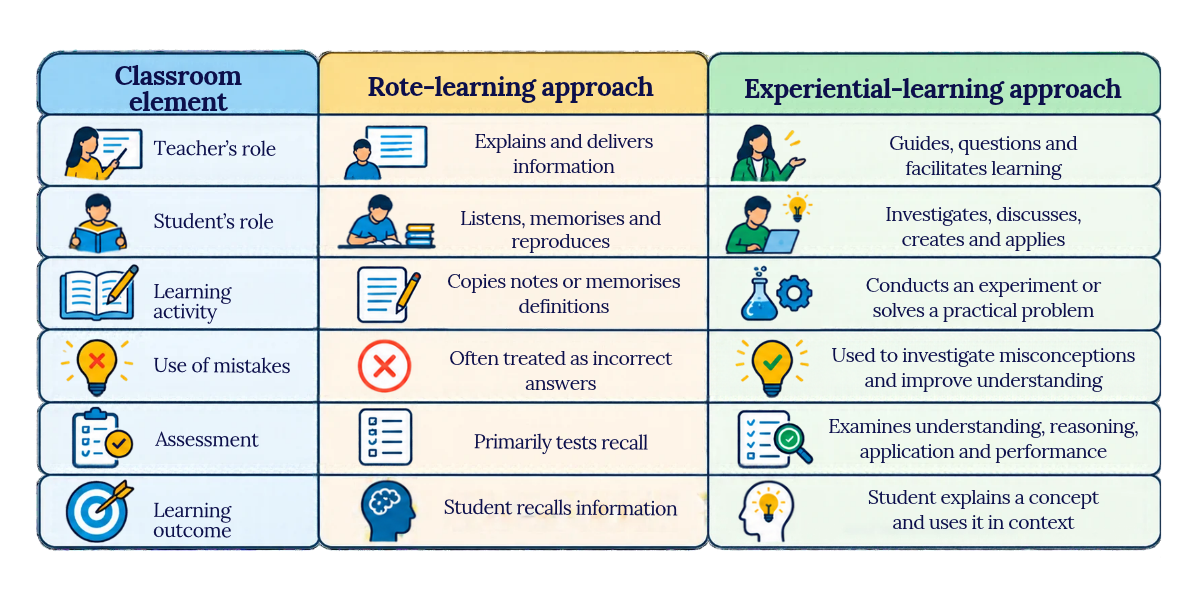
Example: Teaching the Water Cycle
In a conventional lesson, students might memorise evaporation, condensation and precipitation and reproduce their definitions in an examination.
In an experiential lesson, the teacher can:
- Ask students where rainwater comes from and what happens to water after rainfall.
- Demonstrate evaporation and condensation using a simple, safely managed activity.
- Ask students to observe changes and record their findings.
- Help students connect these observations to the stages of the water cycle.
- Ask students to explain how the cycle relates to rainfall, water storage, and the local environment.
The textbook remains useful for introducing terminology and consolidating knowledge. The activity helps students connect those terms with observable processes.
The objective is not to replace explanation with activity. It is to combine explanation, exploration and application so that learning goes beyond recall.
Benefits of Experiential Learning for Students
When planned around clear learning objectives, experiential learning can create opportunities for students to develop conceptual understanding, reasoning, collaboration and practical problem-solving skills. Its effectiveness depends on the quality of the activity, teacher guidance, opportunities for reflection and alignment with assessment.
1. Builds Deeper Conceptual Understanding
Students can connect abstract ideas with observable examples and practical experiences.
For instance, measuring objects helps students understand units and dimensions rather than simply memorising conversion rules.
2. Develops Critical Thinking and Problem-Solving
Activities that require students to predict outcomes, investigate questions, or compare possible solutions encourage them to explain their reasoning.
A science investigation, for example, can ask students to identify why two plants grow differently under different conditions.
3. Encourages Active Participation
Hands-on tasks, discussions, demonstrations, and collaborative projects give students different ways to participate in lessons.
Teachers should design activities so that every learner has a meaningful role rather than allowing only a few confident students to lead.
4. Strengthens Collaboration and Communication
Group projects require students to share responsibilities, discuss ideas, listen to others, and present findings.
These experiences provide opportunities to practise teamwork and communicate evidence-based conclusions.
5. Connects Classroom Learning with Everyday Life
Students can apply mathematics to household budgeting, science to local environmental observations and language skills to interviews or presentations.
These connections help learners recognize where academic concepts are useful beyond examinations.
6. Supports Competency-Based Education
Competency-based education focuses on what learners can understand and do with their knowledge.
Experiential learning can provide evidence of these competencies through experiments, presentations, models, practical tasks, and problem-solving activities.
However, completing a project alone does not establish mastery. Teachers must evaluate the quality of students' reasoning, understanding, and application.
7. Creates Opportunities for Inclusive Learning
Students do not all learn or demonstrate understanding in the same way. A combination of discussion, visual materials, physical activities, written explanations and practical demonstrations can provide different entry points into a lesson.
Activities should be adapted to learners' needs, including accessibility requirements, language needs, and available resources.
Types of Experiential Learning Methods Used in Schools
Experiential learning is not limited to laboratory experiments or expensive educational equipment. Teachers can use a variety of methods depending on the learning objective, age group, classroom environment, and available resources.
1. Hands-On Learning
Students use materials, tools, or objects to explore concepts directly.
- Example: Use measuring cups and water to understand volume.
- Suitable for: Mathematics, Science and Environmental Studies.
2. Project-Based Learning
Students work over a defined period to investigate a question, develop a solution, or create a final product.
- Example: Design a school waste-management plan based on an observation of waste generated in different areas.
- Suitable for: Science, social science, mathematics, and interdisciplinary learning.
3. Inquiry-Based Learning
Students investigate questions, collect evidence, and use their findings to form explanations.
- Example: Investigate why certain materials absorb water while others repel it.
- Suitable for: Science, Geography, and Environmental Education.
4. Activity-Based Learning
Students use structured activities, games, puzzles, models, or demonstrations to understand a concept.
- Example: Use number cards and counters to explore place value and arithmetic.
- Suitable for: Foundational, preparatory and middle-stage learning.
5. Art-Integrated Learning
Teachers use visual art, music, dance, theatre, craft, and other art forms as ways to understand concepts across subjects.
- Example: Create a visual timeline of a historical period or use patterns in traditional art to explore geometry.
- Suitable for: Language, mathematics, history, culture, and interdisciplinary lessons.
6. Sports-Integrated Learning
Physical activities and games become part of the teaching-learning process.
- Example: Use a running activity to record distances, compare times, and calculate average speed.
- Suitable for: Mathematics, physical education, and lessons involving teamwork or movement.
7. Storytelling and Role-Play
Students use stories, scenarios, simulations or role-play to explore ideas and understand different perspectives.
- Example: Conduct a mock local council meeting to discuss water conservation.
- Suitable for: Languages, social science, civic education and communication skills.
8. Field-Based and Community Learning
Students learn by observing their surroundings, interviewing community members or investigating local issues.
- Example: Study a nearby water body, local market or community waste-disposal system and present findings.
- Suitable for: Environmental studies, geography, economics and social science.
9. Digital Simulations and Virtual Labs
Students use simulations to explore processes that may be difficult, costly or unsafe to reproduce in a classroom.
- Example: Use a virtual science experiment to investigate how changing one variable affects an outcome.
- Suitable for: Science, Mathematics and Technology Education.
Digital tools should support active investigation rather than turn experiential learning into passive video-watching.
Experiential Learning Activities Across School Subjects
Experiential learning becomes easier to implement when teachers connect it directly to existing syllabus topics. The following examples illustrate how familiar concepts can be taught through practical tasks.
| Subject | Classroom activity | Learning objective |
|---|---|---|
| Mathematics | Measure classroom objects and calculate their area and perimeter | Apply measurement, geometry and formulas |
| Science | Compare how different materials absorb water | Observe, record and explain results |
| English | Conduct peer interviews and write short profiles | Develop listening, questioning and writing skills |
| Social Science | Map local public facilities and discuss access to services | Understand communities, geography and civic needs |
| Environmental Studies | Audit classroom waste and suggest ways to reduce it | Apply observation, classification and environmental awareness |
| Computer Science | Develop a simple algorithm for sorting classroom objects | Practise sequencing, logic and computational thinking |
| Art Education | Explore symmetry and patterns through local art forms | Connect artistic expression with mathematical concepts |
| Economics or Financial Literacy | Create a mock household budget within a fixed amount | Apply addition, percentages, prioritisation and decision-making |
Example: A Mathematics Activity on Area and Perimeter
Learning objective: Students will distinguish between area and perimeter and apply both concepts to a practical situation.
Activity plan:
- Ask students to measure the length and width of a classroom table or another suitable rectangular surface.
- Have them calculate the perimeter and area using the measurements.
- Ask groups to compare their calculations and explain the difference between the two quantities.
- Present a practical problem: How much border material would be required to go around the table? How much paper would be needed to cover its surface?
- Ask students to justify which measurement is relevant to each problem.
Evidence of learning: Students can select the correct formula, show their calculations, explain the difference between area and perimeter, and apply the concepts to a new example.
This activity requires minimal resources and can be adapted to different grade levels.
How Teachers Can Plan and Implement Experiential Learning
Experiential learning works best when every activity is linked to a specific learning outcome. Teachers do not need to redesign every lesson; they can begin by introducing practical tasks into existing lessons and gradually expand their approach.
TG Gurukul proposes the CLASS Framework as a practical lesson-planning aid. This is a proposed framework, not an official model prescribed by NEP 2020.
The TG Gurukul CLASS Framework
C — Clarify the Learning Outcome
- Identify the concept or competency students should demonstrate.
- Decide what evidence will show that learning has taken place.
L — Launch the Experience
- Introduce a real-world question, problem, demonstration or activity.
- Select materials appropriate to the students' age and available resources.
A — Ask, Observe and Investigate
- Encourage students to experiment, measure, compare, discuss or investigate.
- Use guiding questions to develop reasoning rather than immediately supplying answers.
S — Synthesise the Learning
- Connect students' observations to formal concepts, terminology or principles.
- Address misconceptions that emerge during the activity.
S — Show Learning and Apply
- Ask students to explain their reasoning, demonstrate a skill or solve a new problem.
- Check whether they can apply the concept beyond the original activity.
A Teacher's Checklist
Before conducting an activity, teachers should check that:
- The learning objective is clear and aligned with the curriculum.
- Every student has a meaningful opportunity to participate.
- Materials are safe, accessible and affordable.
- Questions encourage observation and reasoning.
- Time is available to discuss findings and explain the concept.
- Assessment checks understanding and application, not just task completion.
If an activity is engaging but does not help students achieve the intended learning outcome, it needs to be redesigned.
How to Assess Experiential Learning Under NEP 2020
Assessment is an important part of experiential learning because participation alone does not show whether a student has understood a concept.
NEP 2020 calls for assessment to align with learning outcomes, capabilities and dispositions. Paragraph 4.6 specifically discusses assessment of, as and for learning.
Schools can use a combination of methods to evaluate conceptual understanding, practical performance, reasoning and progress.
Three Assessment Approaches
1. Assessment of Learning
- Evaluates what students have learned at a particular point.
- Methods include tests, presentations, completed projects and practical demonstrations.
- Example: Students solve an unfamiliar area-and-perimeter problem after completing a measurement activity.
2. Assessment for Learning
- Helps teachers identify gaps and adjust instruction while learning is in progress.
- Methods include observation, questioning, quizzes, feedback and checks for understanding.
- Example: A teacher notices that students are confusing area with perimeter and introduces another demonstration.
3. Assessment as Learning
- Encourages students to reflect on their own learning and monitor their progress.
- Methods include self-assessment, reflection journals, peer feedback and learning logs.
- Example: Students explain which part of an investigation was difficult and how they arrived at their conclusion.
Practical Assessment Tools for Experiential Learning
| Assessment tool | What it helps evaluate |
|---|---|
| Observation checklist | Participation, use of materials and task-related skills |
| Oral questioning | Conceptual understanding and ability to explain ideas |
| Peer assessment | Ability to review work against shared criteria |
| Practical demonstration | Ability to perform a task or apply a concept |
| Project report | Investigation process, evidence and conclusions |
| Reflection journal | Student thinking, difficulties and learning progress |
| Rubric | Understanding, reasoning, accuracy, creativity and communication |
| Student portfolio | Progress and learning evidence over time |
Example: A Rubric for a Science Investigation
A teacher investigating water absorption can assess students on four criteria:
- Understanding: Can the student explain what water absorption means?
- Investigation: Can the student follow the procedure and make relevant observations?
- Evidence: Can the student record and compare results accurately?
- Reasoning: Can the student explain the findings using the evidence collected?
Criteria should be shared with students before the activity. This makes assessment clearer and helps students understand what they are expected to demonstrate.
Challenges in Implementing Experiential Learning and How Schools Can Address Them
Experiential learning can be implemented in different classroom environments, but teachers may need to adapt their approach to constraints involving time, class size, resources and assessment.
| Challenge | Practical response |
|---|---|
| Limited classroom time | Integrate short, curriculum-aligned activities into existing lessons instead of treating them as additional work. |
| Large class sizes | Organise small groups, assign rotating roles and use structured worksheets to support participation. |
| Limited resources | Use locally available materials, classroom objects and the school environment. Introduce specialised equipment only when necessary. |
| Teacher preparedness | Provide sample lesson plans, activity guides, assessment rubrics and opportunities to practise new teaching methods. |
| Examination-oriented expectations | Connect activities to syllabus concepts and include application-based questions in regular assessments. |
| Unequal student participation | Assign individual responsibilities and combine group projects with individual explanations or demonstrations. |
| Difficulty assessing learning | Use clear criteria to evaluate conceptual understanding, reasoning, practical skills and application—not just task completion. |
The most important principle is adaptation rather than expansion for its own sake. An effective activity does not need to be expensive, lengthy or technologically advanced. It needs to help students achieve a defined learning outcome.
Schools should also account for accessibility, language needs and differences in student readiness so that experiential learning creates meaningful opportunities for all learners.
School Transformation Under NEP 2020: Building a School-Wide Experiential Learning Framework
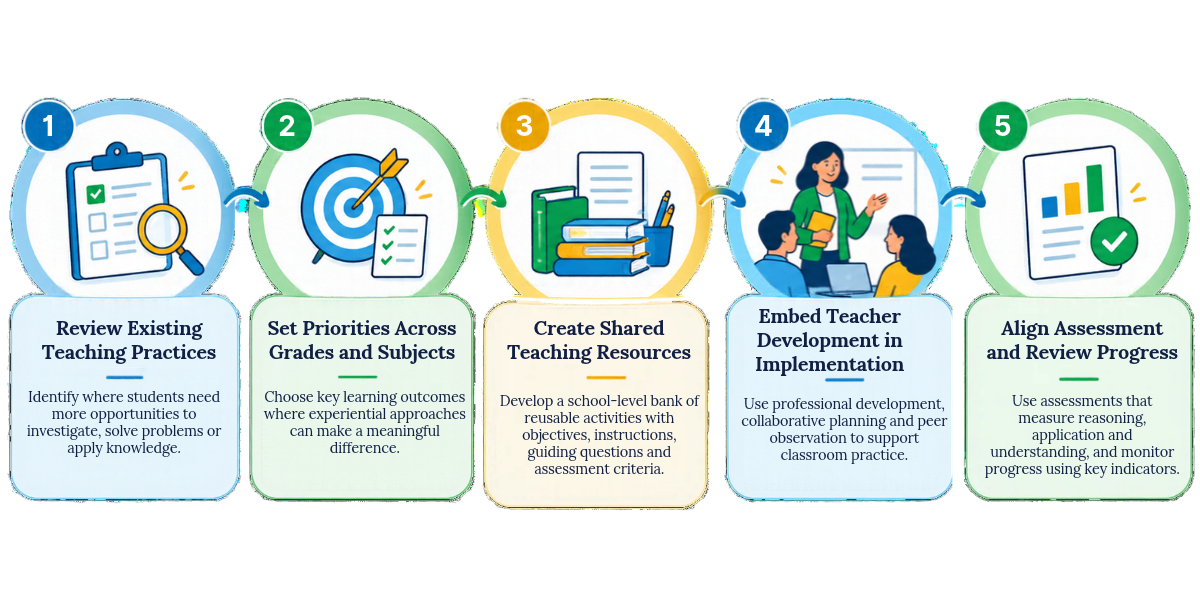
Individual classroom activities are a useful starting point, but sustained implementation requires school leaders to align teaching practices, teacher development, learning resources, and assessment.
A school-wide approach helps experiential learning become part of regular classroom practice rather than an occasional event.
Step 1: Review Existing Teaching Practices
Use classroom observations, teacher discussions, and student work to identify where students need more opportunities to investigate concepts, solve problems, or apply knowledge.
Step 2: Set Priorities Across Grades and Subjects
Identify learning outcomes where experiential approaches can make a meaningful difference. Begin with a manageable number of topics before expanding to other grades or subjects.
Step 3: Create Shared Teaching Resources
Develop a school-level bank of reusable activities that includes learning objectives, preparation requirements, instructions, guiding questions and assessment criteria. This helps teachers plan consistently without creating every activity from scratch.
Step 4: Embed Teacher Development in Implementation
Use professional development sessions, collaborative lesson planning, and peer observation to help teachers design activities, facilitate discussion, and assess student understanding. Training should address actual classroom practice, not only the theory of experiential learning.
Step 5: Align Assessment and Review Progress
Review whether classroom assessments measure recall alone or also evaluate reasoning, practical application and conceptual understanding.
Schools can monitor:
- The range of experiential activities used across subjects.
- Student participation and the quality of their work.
- Common misconceptions identified during lessons.
- Student performance on application-based tasks.
- Teacher feedback on feasibility and classroom effectiveness.
These indicators should be considered alongside actual student work and learning outcomes; activity completion alone does not establish improved learning.
Where TG Gurukul Fits In
TG Gurukul supports school education through learning and assessment programmes, Continuous Professional Development, vocational education and lab solutions spanning AI and Robotics, AR/VR and Astronomy, and STEM-focused learning.
Depending on a school's priorities, these offerings can support teacher preparedness, practical learning opportunities and the connection between curriculum concepts and real-world applications.
The appropriate approach depends on the school's objectives, infrastructure, student needs and implementation capacity. The starting point should always be the learning outcome—not the equipment, technology or activity itself.
Conclusion
Experiential learning under NEP 2020 is about helping students move beyond memorising information to understanding concepts and applying them in real-life situations.
Schools can begin with simple, curriculum-aligned activities that encourage students to explore, question, solve problems and reflect on their learning. With thoughtful planning and meaningful assessment, these practices can gradually transform classroom experiences.
Ultimately, the success of NEP 2020 lies not just in its implementation, but in how effectively it changes the way students learn.
Key Takeaways
- Experiential learning connects concepts with experience, reflection and application.
- NEP 2020 promotes experiential learning across subjects and school stages.
- Learning by doing can be implemented through low-cost activities, projects, experiments, storytelling, art, sports and community-based tasks.
- Teachers should align activities with learning outcomes and assess students' understanding, reasoning and ability to apply knowledge.
- School-wide implementation requires teacher support, appropriate resources, aligned assessment and ongoing review.
- The goal is not simply to make lessons more engaging; it is to help students understand concepts and use their knowledge meaningfully.
Upcoming Blogs
- Vocational Education in Schools: Preparing Students for Careers and the Future of Work.
- Future-Ready Schools: How AI, Robotics, Vocational Education & Life Skills Prepare Students for 2030.
- Skill-based learning for classes 6–12: what students should learn beyond textbooks.